China Top 10 Carbon Steel Shaft Manufacturers
Selecting reliable Carbon Steel Shaft manufacturers requires more than comparing catalog prices. A shaft may look simple, yet its performance depends on steel grade, heat treatment, machining accuracy, and surface condition. In industrial equipment, a small deviation can create vibration, premature wear, or difficult assembly.
This guide examines China’s top 10 Carbon Steel Shaft manufacturers through practical and technical criteria. These include production experience, material traceability, CNC machining capability, dimensional control, and quality inspection. Important details include shaft diameter, keyway accuracy, straightness, hardness, and allowable runout. A dependable supplier should also provide inspection reports, mill certificates, and clear heat-treatment records.
Factory capability matters. A serious manufacturer should show calibrated measuring equipment, organized workshops, and repeatable processes. Sample checks may include micrometer readings, hardness testing, magnetic particle inspection, and visual surface review. Packaging also deserves attention. A long shaft needs support against bending during transport.
No ranking is flawless. Supplier performance can change with equipment, staffing, or project complexity. Some manufacturers communicate well but lack advanced testing. Others offer impressive machinery yet provide limited documentation. That difference matters.
The selection process should match the shaft’s actual working conditions. Load, rotation speed, corrosion exposure, and connection design all influence the correct specification. Experienced buyers should request drawings, tolerances, sample approval, and production timelines before placing large orders. These steps reduce surprises, although they cannot remove every risk.
The manufacturers discussed here represent useful options for construction machinery, agricultural equipment, transmission systems, and custom engineering projects. Readers should verify current certifications and capabilities directly. Careful comparison remains essential.
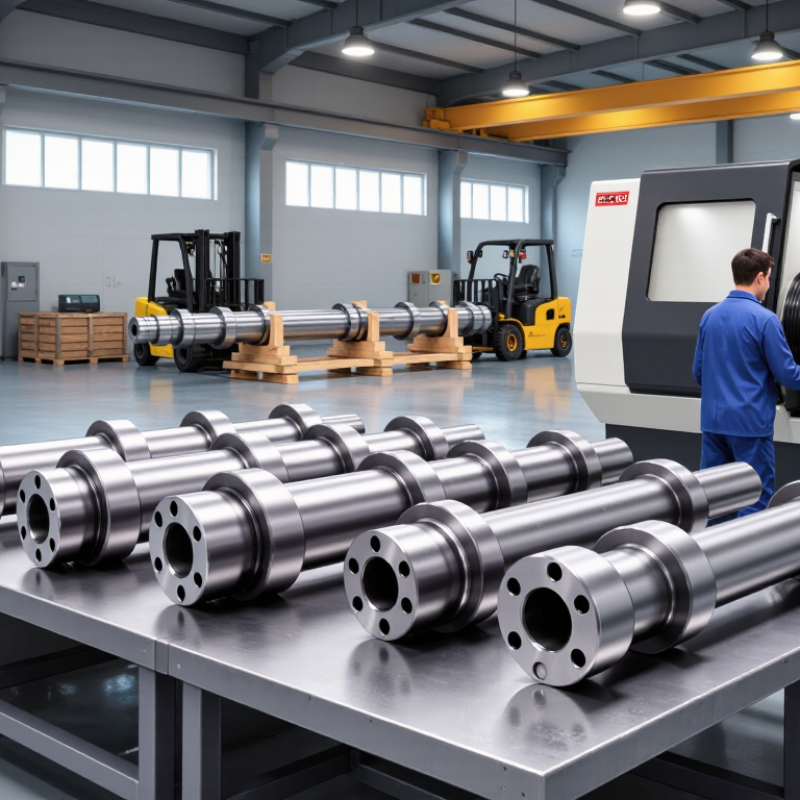
Carbon Steel Shafts: Definition, Types, and Industrial Applications
Carbon steel shafts are cylindrical machine components that transmit torque, motion, or supporting loads. Carbon steel combines iron with controlled carbon content and practical machinability. In workshop inspections, shaft failure often begins with poor alignment or surface damage.
Common types include solid, hollow, stepped, keyed, splined, and threaded shafts. Solid shafts handle demanding loads. Hollow shafts reduce weight and inertia. Stepped shafts position bearings, seals, and gears along one body.
Keyed and splined shafts transfer rotational force between connected parts. Threaded ends secure nuts or couplings. These categories may overlap.
Industrial applications include conveyors, pumps, gearboxes, agricultural machines, compressors, and material-handling systems. A drive shaft needs accurate balance and reliable torsional strength. Pump shafts require suitable surface protection because carbon steel can corrode in wet environments. Low-carbon grades offer easy machining, while medium-carbon grades provide a useful balance of strength and toughness. Higher-carbon grades can improve hardness, but excessive hardness may reduce impact resistance.
Heat treatment, straightness, runout, surface finish, and dimensional tolerances should be verified before installation.
Material certificates and hardness reports also improve traceability. Small errors matter.
When comparing manufacturers, inspect testing procedures, machining capability, packaging, and production experience. A bright surface does not prove internal quality. I have seen specifications appear complete while omitting keyway tolerances. That detail deserves a second review.
Key Standards for Evaluating Chinese Shaft Manufacturers
China Top 10 Carbon Steel Shaft Manufacturers
Evaluating Chinese carbon steel shaft manufacturers requires more than comparing prices. The World Steel Association reported China produced about 1.005 billion tonnes of crude steel in 2024. This scale supports strong supply capacity, but it does not guarantee shaft quality. Buyers should verify steel heat numbers, chemical composition, tensile strength, hardness, and impact results through independent laboratory reports.
Production controls deserve close attention. The ISO Survey 2022 recorded more than 1.7 million ISO 9001 certificates in China. A certificate helps, but it is not proof of consistent shaft performance. Ask whether the manufacturer follows ASTM A29/A29M, EN 10277, or equivalent material requirements. Check dimensional tolerances against ISO 286, especially for bearing seats and keyways. Measure runout, surface roughness, straightness, and concentricity on actual production samples.
Traceability is practical evidence. Each shaft should connect to a steel heat, forging record, heat-treatment chart, and final inspection report. Look for calibrated instruments, non-destructive testing, and documented corrective actions. Magnetic-particle testing can reveal surface cracks after machining. Ultrasonic testing may identify internal discontinuities. Small details matter.
A factory visit can expose gaps that documents hide. Still, audits can be imperfect. Request three recent batches, not one impressive sample. Confirm packaging, corrosion protection, and loading methods before approval. Reliable suppliers explain rejected parts openly, although that honesty is sometimes harder to find than a polished certificate.
China’s Top 10 Carbon Steel Shaft Manufacturers
China’s Top 10 Carbon Steel Shaft Manufacturers
China’s top carbon steel shaft manufacturers serve automation, agricultural machinery, pumps, and industrial transmission systems. Their capabilities often include cutting, turning, milling, heat treatment, grinding, and surface protection. A serious comparison should examine process control, not only production volume or quoted price.
The strongest manufacturers usually provide material certificates, dimensional inspection reports, and traceable batch records. Common materials include medium-carbon grades selected for strength, machinability, and wear resistance. Engineers should check shaft diameter, straightness, hardness, keyway accuracy, and concentricity. Even a small runout error can create vibration in a rotating assembly.
Production experience matters. Skilled technicians understand how quenching and tempering affect distortion. Modern coordinate measuring equipment improves inspection reliability. Still, equipment alone does not guarantee stable results. A supplier should explain its sampling plan, corrective actions, and final inspection method. Ask for practical evidence.
The top 10 list should also consider communication and customization. Manufacturers that review drawings carefully can identify weak shoulders, unsuitable tolerances, or poor fillet design before production. That saves time. Yet no supplier is flawless. Some published specifications may hide limitations in coating life, delivery consistency, or small-batch support. Buyers should request samples and test them under real loads. Independent verification remains valuable, especially for safety-critical shafts.
Manufacturing Processes and Quality Control Practices
China Top 10 Carbon Steel Shaft Manufacturers
Manufacturing quality begins with steel selection, not final inspection. World Steel Association’s World Steel in Figures 2024 reports that China produced about 1,019 million tonnes of crude steel in 2023. This scale supports stable material sourcing, but volume does not guarantee shaft reliability. Manufacturers commonly use medium-carbon steel, controlled heating, CNC turning, keyway milling, and grinding. Forging can refine the grain structure before machining. Heat treatment then adjusts hardness, strength, and wear resistance.
Process control must remain measurable. Production teams check chemical composition with spectrometers and verify dimensions using calibrated micrometers, CMM equipment, and roundness gauges. Tensile testing should follow ISO 6892-1, while material grades and mechanical requirements often reference ASTM A29 or equivalent standards. Non-destructive testing, including magnetic particle inspection, can reveal surface cracks after grinding. Small errors matter. A few microns may affect assembly, vibration, or seal life.
ISO’s 2023 Survey of ISO 9001 certificates shows millions of certified sites worldwide, yet certification alone cannot prove shaft performance. Traceability records should connect each shaft to its heat number, furnace cycle, operator, and inspection result. Statistical process control helps identify drift before rejection rates rise. In practice, some factories still depend too heavily on final inspection. That is a weakness. A perfect shaft is a useful fiction; consistent control is the real target. Calibration intervals, sampling plans, and corrective-action records deserve the same attention as machining speed.
How to Select the Right Carbon Steel Shaft Supplier
China Top 10 Carbon Steel Shaft Manufacturers
How to Select the Right Carbon Steel Shaft Supplier
A capable carbon steel shaft supplier should match grade, load, geometry, and heat treatment to your application. AISI 1045 may suit moderate torque, while higher-strength grades need careful machining and stress control. Request mill certificates showing chemical composition, tensile strength, hardness, and heat-treatment records. ASTM A29/A29M provides useful requirements for carbon and alloy steel bars.
Production scale can be misleading. The World Steel Association reported about 1.89 billion tonnes of crude steel production worldwide in 2023, but volume does not prove shaft quality. Ask for sample inspection data, including diameter tolerance, straightness, surface roughness, and keyway accuracy. Magnetic-particle testing can reveal surface cracks after machining. For critical shafts, request ultrasonic testing and a traceable inspection report.
Quality systems matter.
The ISO Survey 2023 recorded more than 1.2 million ISO 9001 certificates globally. Certification is helpful, not decisive. Audit the supplier’s process instead of accepting a certificate alone. Check calibration records, batch identification, furnace controls, and packaging protection against rust. A small trial order can expose poor communication, inconsistent hardness, or delayed corrections. One weakness remains easy to miss: some suppliers provide excellent samples but weaker mass production. Define acceptance limits in writing, inspect the first batch independently, and review failure data before approving long-term supply.
