Buying Stainless Threaded Rod can look simple until a rod bends, rusts, or refuses to fit the nut. The right choice depends on more than diameter and price. You must examine grade, thread form, length, strength, surface condition, and operating environment.
Carmen Vertullo, a recognized fastener metallurgy specialist, puts it plainly: “Stainless steel is not automatically corrosion-proof; the environment decides.” That warning deserves attention. A 304 Stainless Threaded Rod may perform well indoors, while 316 is often more suitable near saltwater or chemical exposure. Still, grade alone cannot guarantee success. Crevices, contamination, poor storage, and damaged threads can create early corrosion.
Measure carefully.
Before ordering, confirm the nominal diameter, thread pitch, thread direction, and required cut length. Check whether the rod follows a relevant standard, such as DIN 976, and request material certificates when the application is critical. Inspect the threads visually. They should appear continuous, clean, and free from flattened sections. A reputable supplier should explain tensile properties, tolerances, packaging, and traceability without vague promises.
The ten tips in this guide focus on practical buying decisions. They cover material selection, corrosion exposure, dimensional accuracy, load requirements, nut compatibility, finish, certification, quantity, supplier evaluation, and final inspection. Some recommendations may seem obvious. They are often missed.
One honest limitation remains: no checklist replaces engineering judgment. A rod supporting a handrail is not equivalent to one used in a vibrating machine or a structural assembly. When the consequences matter, have the specification reviewed by a qualified engineer before purchase.
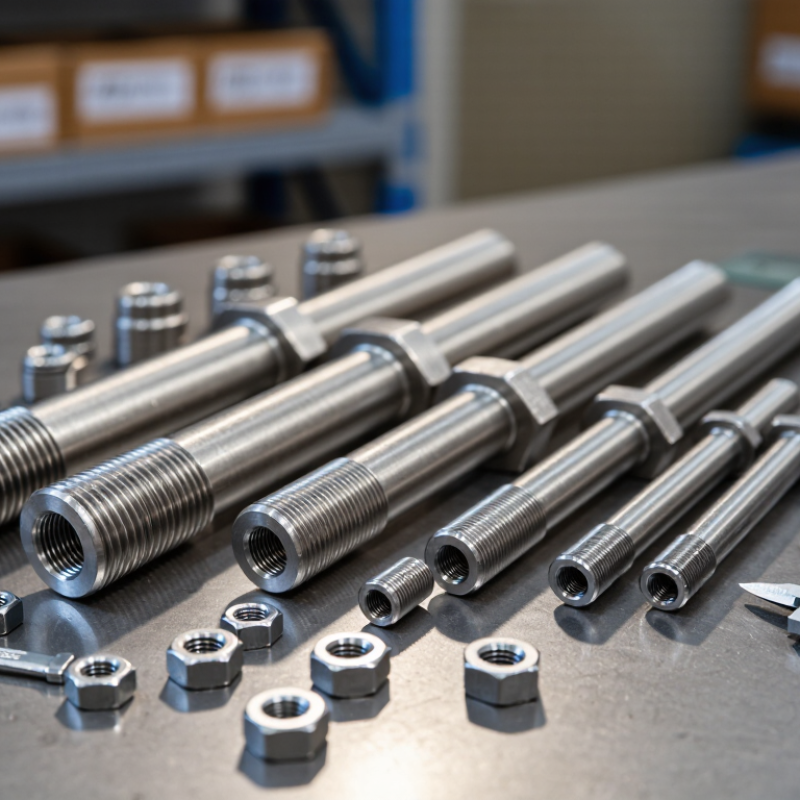
Before buying stainless threaded rod, define what the assembly must survive. Start with the working load, not the rod’s appearance. Include tension, shear, vibration, and any bending caused by poor alignment. A lightly loaded bracket needs different capacity from a structural support. I once selected a diameter from a static load alone. That shortcut looked efficient, but vibration later exposed the weakness.
Check the environment carefully. Indoor dry service differs greatly from coastal air, cleaning chemicals, or constant moisture. Identify possible chloride exposure, chemical contact, and trapped water around washers and nuts. Stainless steel is corrosion resistant, not corrosion proof. Choose a suitable stainless grade only after reviewing the actual conditions. Also inspect the mating hardware. Dissimilar metals can create problems, and galling can damage threads during tightening.
Temperature changes the decision. Record normal, minimum, and maximum temperatures, including short heat spikes. Strength, expansion, lubrication, and preload can all change with temperature. Then estimate the required service life and maintenance access. A rod inside a sealed wall may need more conservative material selection than one that can be inspected monthly. Review supplier test data, dimensions, thread accuracy, and traceability before purchase. When calculations seem uncertain, ask a qualified engineer to check them. Measure twice. Document the assumptions.
When buying stainless threaded rod, compare corrosion resistance before price or thread size. The key indicator is PREN, or Pitting Resistance Equivalent Number. The common formula is %Cr + 3.3×%Mo + 16×%N. Typical 304 stainless steel reaches a PREN near 18, while 316 commonly reaches about 24. These values reflect published chemistry ranges in ASTM A276 and technical guidance from the Nickel Institute.
That difference matters near salt spray, coastal air, chlorides, and damp processing areas. In those conditions, 316 usually offers better resistance to pitting because it contains molybdenum. Still, PREN is not a guarantee. It does not fully predict crevice corrosion beneath washers, nuts, or trapped dirt. I have seen clean-looking 304 rods stain quickly when water remained inside a threaded joint. A poor installation can defeat better material.
Check the material certificate, heat number, and chemical composition. Do not rely only on “stainless” stamped on packaging. Confirm whether the rod is 304 or 316, then inspect thread quality and surface damage. The European Stainless Steel Development Association notes that fabrication, contamination, and surface condition strongly influence stainless performance. For ordinary indoor fastening, 304 may be practical. For marine exposure, chemical splashes, or frequent washing, 316 is the safer choice. PREN helps, but the surrounding details still deserve attention.
PREN, or Pitting Resistance Equivalent Number, is a useful comparison of localized corrosion resistance. Typical values are approximately 18 for 304 stainless steel and 24 for 316 stainless steel.
Use 304 for general indoor, dry, and low-chloride applications. Consider 316 for marine, coastal, chemical, or chloride-rich environments.
Confirm thread diameter, pitch, length, thread class, and the required load capacity before ordering.
Check galvanic compatibility with nuts, washers, and connected parts. Avoid contamination from carbon-steel tools or storage surfaces.
Request material certification and verify that the supplied alloy meets the specified standard. PREN values vary with actual chromium, molybdenum, and nitrogen content.
Approximate PREN values shown for comparison: PREN = %Cr + 3.3 × %Mo + 16 × %N. Actual performance depends on composition, surface condition, temperature, and exposure conditions.
10 Tips for Buying Stainless Threaded Rod: Verify Size and Threads
Thread identification prevents expensive assembly errors. ISO 965-1 defines metric thread tolerances, including the external-thread class 6g. The “6” indicates tolerance grade, while “g” identifies the tolerance position. It does not describe stainless-steel strength or corrosion resistance. Confirm the nominal diameter, pitch, and 6g designation on the drawing and inspection record. A 10 mm rod with a 1.5 mm pitch is not interchangeable with a 10 mm rod having a 1.25 mm pitch. Small differences matter.
For inch products, ASME B1.1 defines Unified National Coarse and Fine threads, such as UNC and UNF. It also lists external classes 1A, 2A, and 3A. Most general assemblies use 2A, but the purchase specification must decide. Check threads per inch with a calibrated pitch gauge, then test the rod with a matching nut or ring gauge. Do not rely on diameter alone. I have seen clean-looking rods fail because the pitch was wrong. Stainless threads can also gall during trial fitting, especially when forced or dry. Use controlled hand engagement and inspect the first few threads under good lighting. One detail deserves rechecking: suppliers may print “metric” without stating tolerance class. That omission is not harmless. Ask for the standard, inspection method, and material certificate before approving delivery.
| No. | Buying Check | Recommended Specification | How to Verify | Example or Acceptance Guidance |
|---|---|---|---|---|
| 1 | Confirm the thread system | Use metric ISO threads or Unified inch threads; do not mix the two systems. | Check the purchase order, drawing, packaging, and thread gauge designation. | Metric: M12 × 1.75. Inch: 1/2-13 UNC or 1/2-20 UNF. |
| 2 | Verify nominal diameter | Specify the nominal major diameter, not only the overall length. | Measure the outside diameter with a calibrated micrometer or compare it with a known gauge. | A nominal M12 rod has a major diameter close to 12 mm; actual limits depend on the specified tolerance class. |
| 3 | Check pitch or threads per inch | For metric rods, state pitch in millimeters. For Unified threads, state UNC or UNF and TPI. | Use a pitch gauge or count the threads over a measured length. | M12 × 1.75 has a 1.75 mm pitch; 1/2-13 UNC has 13 threads per inch; 1/2-20 UNF has 20. |
| 4 | Specify the external thread tolerance | For metric external threads, clearly state the required tolerance class, commonly 6g, in accordance with the applicable ISO 965 requirements. | Review the certificate or inspect with a calibrated GO/NO-GO ring gauge. | A drawing may specify M12 × 1.75 - 6g. The tolerance class must not be assumed when it is critical to fit. |
| 5 | Choose the correct inch thread class | Use ASME B1.1 UNC for coarse threads or UNF for fine threads when an inch specification is required. | Match the rod with the corresponding calibrated Unified thread ring gauge. | Typical identification: 3/8-16 UNC or 3/8-24 UNF; UNC and UNF are not interchangeable. |
| 6 | Select the stainless-steel grade | Choose the grade according to corrosion exposure, strength, temperature, and fabrication requirements. | Request material identification and review the material certificate where traceability is required. | Common choices include austenitic 304 for general environments and 316 for improved resistance to chloride-containing environments; grade suitability must be assessed for the application. |
| 7 | Check length and cut-end condition | State the nominal cut length, length tolerance, end squareness, and whether chamfering is required. | Measure the length and inspect both ends for burrs, damaged threads, or incomplete first threads. | A chamfered end helps nut starting; the specified length tolerance should be confirmed on the drawing or order. |
| 8 | Evaluate corrosion and surface condition | Require a clean, continuous threaded surface free from deep scratches, folds, rust staining, and embedded carbon steel. | Perform visual inspection and confirm the required cleaning, passivation, or surface-finish condition. | Stainless steel is corrosion resistant, but contamination, crevices, chlorides, and unsuitable environments can still cause corrosion. |
| 9 | Confirm mechanical requirements | Specify the required tensile strength, proof load, yield strength, or property class where the rod is load-bearing. | Review the applicable product standard and material test certificate; do not infer strength from appearance. | A corrosion-resistant grade may not provide the required load capacity. Design loads, thread engagement, and installation conditions must also be considered. |
| 10 | Check nut compatibility and galling risk | Use a nut with the same thread system, diameter, pitch, and compatible material; consider suitable lubrication during assembly. | Test-fit a representative nut by hand before applying a wrench or torque. | Stainless-on-stainless contact can gall, especially with high speed, high pressure, or dry assembly. Stop if resistance or binding occurs. |
Specification example: Stainless threaded rod, M12 × 1.75 - 6g, 304 stainless steel, specified cut length, chamfered ends, and inspection with a calibrated metric GO/NO-GO ring gauge.
When buying stainless threaded rod, check the strength grade before comparing price or surface finish. ISO 3506 A2-70 specifies a minimum tensile strength of 700 MPa. A4-80 raises that minimum to 800 MPa. These figures describe tensile strength, not the safe working load. They should never replace an engineer’s calculation.
The difference matters under vibration, tension, and repeated assembly. A4-80 is often selected for demanding or corrosive environments, especially where chloride exposure may occur. A2-70 can suit many indoor and mildly humid applications. Still, “stainless” does not mean corrosion-proof. I have seen rods fail after moisture collected inside poorly drained joints.
Check the thread diameter, pitch, length, and nut compatibility together. A strong rod is useless if the connection strips or bottoms out. Ask for material certificates that identify the grade and mechanical properties. Confirm whether the marking refers to the rod itself, not only the packaging. Small details matter.
Do not rely on appearance.
Inspect the threads for dents, rolled-over crests, and uneven cutting. Cut threads may alter the surface and create sharp starting points for corrosion. This is easy to overlook. Also consider preload, washers, temperature, and galvanic contact with other metals. The grade may be correct, yet the assembly can still be unsafe. Recheck the specification against the actual load, site conditions, and installation method before ordering.
10 Tips for Buying Stainless Threaded Rod
Buying stainless threaded rod requires more than checking diameter and thread pitch. Confirm the finish before comparing prices. Bright, dull, or passivated? Each option affects appearance, corrosion resistance, and application performance. Ask whether the surface was cleaned after machining. Small burrs can damage nuts, washers, or workers’ gloves during installation.
Certification deserves equal attention. Request a material test report showing the stainless grade, heat number, chemical composition, and mechanical results. Check that the document matches the delivered lot, not just a general product sheet. Relevant dimensional or material standards should be clearly identified. I once saw a shipment with correct labels but incomplete traceability. That delay was avoidable. Verify thread tolerance, straightness, length, and cut-end condition before approval.
Quantity changes the real price. Compare unit cost, packaging, freight, inspection fees, and possible waste from short pieces. Ask for a sample when the order is large. Supplier quality depends on more than polished communication. Review inspection records, production capability, storage methods, and response procedures for defects. Can the supplier explain how rods are protected from contamination? Can they replace nonconforming pieces promptly? Get these answers in writing. A low quotation may hide inconsistent threads, mixed grades, or poor packing. I would also request photographs of the actual batch, although photographs cannot replace independent inspection.
MSIRobot