
How to Choose the Best pH Meter for Your Needs?
Choosing the best Ph Meter begins with understanding the measurement, not comparing prices alone. A laboratory technician may need exceptional accuracy, while a pool owner may value simple calibration and water resistance. The right instrument should match the sample, testing frequency, temperature range, and required precision.
Dr. Roger G. Bates, a leading authority on pH measurement, wrote, “The pH scale is an operational scale.” This principle matters because reliable readings depend on the entire testing process. The electrode, buffer solutions, sample preparation, and temperature compensation all influence results. A high-priced meter can still produce poor data when its probe is neglected. That is an uncomfortable truth.
Look closely at electrode quality. A glass bulb suited to clean water may perform poorly in thick food products or soil extracts. For frequent field testing, choose a Ph Meter with automatic temperature compensation, a clear display, strong battery life, and durable housing. For laboratory work, data logging, calibration reminders, and replaceable probes may matter more.
Calibration should feel practical, not mysterious. Two- or three-point calibration usually gives better confidence across different pH ranges. Fresh buffers are essential. Old buffers can quietly mislead you.
I have learned that convenience often decides whether testing is done correctly. A complicated instrument may be technically impressive, yet ignored in daily use. Check service support, replacement electrode costs, warranty terms, and cleaning requirements before purchasing. The best Ph Meter is not always the most advanced model. It is the one that produces dependable readings in your actual working conditions.
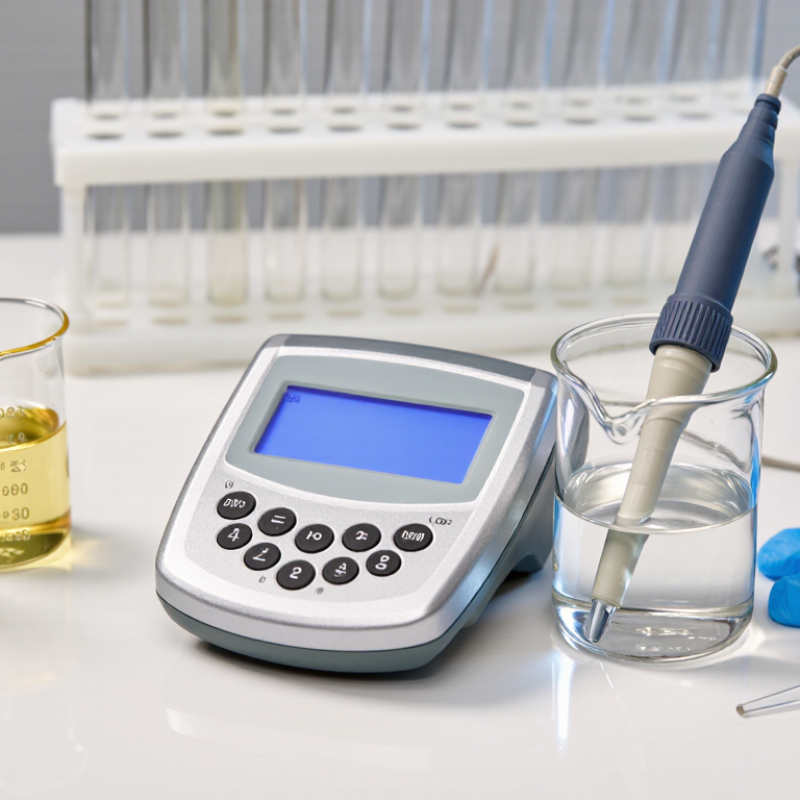
Understanding pH Meter Types and Their Measurement Principles
How to Choose the Best pH Meter for Your Needs?
A pH meter measures hydrogen ion activity through an electrical potential difference. Most routine meters use a glass electrode and a reference electrode. The glass membrane responds selectively to hydrogen ions in the sample. The meter then converts voltage into a pH reading using the Nernst equation. That small signal needs careful handling.
Portable meters suit water testing, food production, and field sampling. They usually offer compact probes and battery power. Benchtop meters provide better stability for laboratories and repeated measurements. Pen-style meters are convenient, but their smaller probes may be less durable. Combination electrodes place both sensing elements in one body. This design reduces setup time and limits alignment errors.
Some meters use solid-state sensors, such as ion-sensitive field-effect transistors. They resist glass breakage and can respond quickly. However, their performance may vary with sample composition and temperature. Automatic temperature compensation improves accuracy, but it cannot correct a dirty or poorly conditioned electrode. Calibrate with fresh buffer solutions near the expected sample range. Rinse with purified water, then blot gently. Do not wipe the glass membrane.
In practical testing, I have seen unstable readings caused by trapped air around the bulb. Slow stabilization can also indicate aging reference solution. I once trusted a stable display too quickly; the electrode had not fully equilibrated. That mistake changed my view of “fast” instruments. Check slope, repeatability, and maintenance requirements before choosing a meter. A reliable reading begins with the sensor, not the screen.
How to Choose the Best pH Meter for Your Needs? - Understanding pH Meter Types and Their Measurement Principles
| pH Meter Type | Measurement Principle | Main Advantages | Important Limitations | Typical Applications | Typical Resolution | Calibration Considerations |
|---|---|---|---|---|---|---|
| Glass-Electrode pH Meter | A hydrogen-ion-sensitive glass membrane generates a potential difference relative to a reference electrode. The meter converts this voltage into pH using the Nernst equation. | High measurement accuracy; suitable for many aqueous samples; widely available in laboratory and field formats. | The glass bulb is fragile; readings can be affected by temperature, contamination, dehydration, and low-conductivity samples. | Water testing, food analysis, education, environmental sampling, chemical laboratories, and general quality control. | Commonly 0.01 pH; some laboratory instruments display 0.001 pH. | Use at least two suitable buffer points; three-point calibration is preferred when measuring across a broad pH range. Rinse without wiping aggressively. |
| Combination pH Electrode Meter | The measuring glass electrode and reference electrode are integrated into one probe, producing a single practical sensor assembly. | Simple handling; requires only one probe; convenient for routine measurements and compact instruments. | The reference junction may clog or become contaminated; one worn component generally requires replacement of the complete combination electrode. | Routine laboratory work, production checks, water quality testing, and general-purpose pH measurements. | Usually 0.01 pH; advanced systems may provide 0.001 pH display resolution. | Calibrate with fresh buffers that bracket the expected sample pH. Store the electrode in the recommended storage solution, not in pure water. |
| ISFET pH Meter | An ion-sensitive field-effect transistor detects hydrogen-ion activity through a chemically sensitive surface, without a fragile glass bulb. | Highly resistant to breakage; fast response; useful for small volumes, field work, and applications requiring a solid-state sensor. | Sensor performance can vary with temperature, surface contamination, aging, and sample composition; replacement sensors may be specialized. | Portable testing, biotechnology, food processing, medical research, micro-sampling, and measurements where glass damage is a concern. | Commonly 0.01 pH, depending on sensor design and instrument electronics. | Calibrate regularly with traceable buffers; allow the sensor to reach thermal equilibrium and clean the sensing surface according to the manufacturer’s procedure. |
| Differential pH Meter | Uses a pH-sensing electrode together with a differential reference system designed to reduce errors caused by unstable reference potentials or difficult sample matrices. | Improved stability in dirty, changing, or chemically challenging samples; can reduce some junction-related measurement problems. | Generally more expensive; electrodes and maintenance procedures may be more specialized than standard combination systems. | Wastewater, slurries, emulsions, industrial process samples, and samples with frequent reference-junction contamination. | Commonly 0.01 pH; exact resolution depends on the instrument configuration. | Use matrix-appropriate buffers and follow the electrode-specific cleaning procedure. Check calibration slope and offset when sample conditions change. |
| Portable Handheld pH Meter | Usually uses a glass combination electrode or solid-state sensor connected to battery-powered electronics for on-site electrochemical measurement. | Lightweight; convenient for field sampling; often includes automatic temperature compensation and data storage. | Battery condition, sample temperature, probe care, and environmental exposure can influence performance; generally has fewer advanced controls than a benchtop unit. | Pools, aquaculture, agriculture, drinking water checks, environmental surveys, and mobile production testing. | Typically 0.01 pH; accuracy depends on the sensor and calibration condition. | Calibrate before field use when possible. Protect the probe from drying, rinse between samples, and verify readings with a check buffer when results are critical. |
| Benchtop Laboratory pH Meter | Measures the potential generated by a pH electrode and reference system, with laboratory electronics providing stable input measurement, temperature compensation, and data functions. | High repeatability; larger display; advanced calibration records; support for automatic temperature compensation, multiple data points, and specialized electrodes. | Less portable; requires a stable workspace and regular electrode maintenance; higher purchase and operating cost than basic handheld meters. | Research laboratories, pharmaceutical and food quality control, formulation work, academic testing, and regulated measurement workflows. | Often 0.001 pH display resolution, although practical accuracy depends on calibration, electrode condition, temperature, and sample properties. | Use fresh, temperature-appropriate certified buffers; perform multi-point calibration when required; document slope, offset, temperature, and electrode condition. |