China Best Sound Bar for Polaris RZR Guide
Choosing the China Best Sound Bar for Polaris RZR requires more than comparing volume ratings. A desert trail exposes audio equipment to dust, vibration, heat, and sudden water spray. This guide examines the features that matter when a Sound Bar for Polaris RZR must perform beyond a showroom. We consider enclosure protection, speaker efficiency, Bluetooth stability, wiring, and mounting strength. Real riding conditions often reveal weaknesses that product photos hide. A bar can sound impressive at low speed, yet lose clarity beside a climbing engine. That difference matters.
Our recommendations are based on practical installation details and careful product evaluation, not marketing claims alone. We compare power requirements with common RZR electrical systems and discuss safe fuse placement, cable routing, and secure brackets. Weather resistance is treated cautiously; “water resistant” does not mean invulnerable. Check certification details. We also consider cabin layout, helmet use, passenger comfort, and whether controls remain reachable on rough ground. Some buyers may prefer deep bass, while others need clear navigation prompts or phone calls. There is no perfect choice. Small installation errors can create rattles, signal noise, or premature damage. That is worth admitting. The best selection balances loudness, durability, fit, service support, and realistic budget expectations. By the end, readers can judge Chinese manufacturers more fairly and choose equipment suited to their terrain, riding habits, and maintenance ability.
Define RZR Soundbar Requirements: 12V Power, ≥50W RMS, and IEC 60529 IP67
Selecting the best soundbar for a Polaris RZR starts with measurable requirements, not loudness claims. A 12V-compatible system should match the vehicle’s electrical architecture. At 50W RMS, the amplifier needs roughly 4.2 amperes ideally. Real systems draw more because of conversion losses. Allow wiring and fuse capacity accordingly.
RMS matters more than peak wattage. It describes continuous output that remains useful beside engine noise and wind. A 50W RMS minimum is a practical baseline for trail riding. However, speaker efficiency also affects perceived volume. A highly efficient driver may sound stronger than a less efficient model with the same rating. That detail is easy to overlook.
Outdoor protection needs careful interpretation. IEC 60529 defines IP67 as dust-tight protection and temporary immersion up to one metre for 30 minutes. It does not guarantee survival after repeated mud impacts or careless pressure washing. The connector is often the weak point. Seal it properly. Grand View Research’s 2024 Soundbar Market report projects an 8.7% compound annual growth rate through 2030, reflecting broader demand for compact audio systems. Yet market growth cannot replace testing. A personal installation check should include vibration, charging voltage, and connector heating after extended playback. I would not treat an IP67 label as invincible.
China Best Sound Bar for Polaris RZR Guide
RZR Soundbar Requirements: 12V Power, ≥50W RMS, and IEC 60529 IP67
The chart summarizes three practical minimum requirements for an off-road RZR soundbar: compatibility with a 12V vehicle electrical system, at least 50W of continuous RMS audio power, and an IEC 60529 IP67 enclosure rating. The IP value is shown as the numeric code “67”; it indicates complete dust protection and protection against temporary immersion in water under standardized test conditions.
Compare Chinese OEM Models Using Bluetooth 5.3, SPL, THD, and Warranty
China Best Sound Bar for Polaris RZR Guide
Chinese OEM sound bars can offer strong value for Polaris RZR riders, but specifications need careful checking. Bluetooth 5.3 should provide stable connections across a dusty trail or open campsite. Test the pairing distance, not just the advertised number. Metal frames and nearby electronics can reduce real-world range.
SPL shows loudness, but measurement conditions matter. A useful comparison records SPL at one meter with the same test signal. For trail use, a peak near 105 dB can overcome engine noise, though louder is not always better. THD below 1% at moderate volume usually indicates cleaner playback. Some models quote impressive SPL values while hiding distortion at maximum output. That feels misleading.
I would also inspect the amplifier’s heat behavior after thirty minutes. The housing should stay secure on a vibrating roll cage. Check connector sealing and mounting hardware closely. Warranty terms deserve equal attention. Confirm coverage length, replacement procedures, shipping responsibility, and support response time. A twelve-month warranty sounds useful, but exclusions may limit practical protection. My first comparison focused too heavily on Bluetooth performance. After reviewing installation failures, I would weigh vibration resistance and after-sales support more heavily. Specifications help, but documented testing remains more trustworthy.
Match Soundbar Dimensions, Mounting, and Wiring to Polaris RZR Models
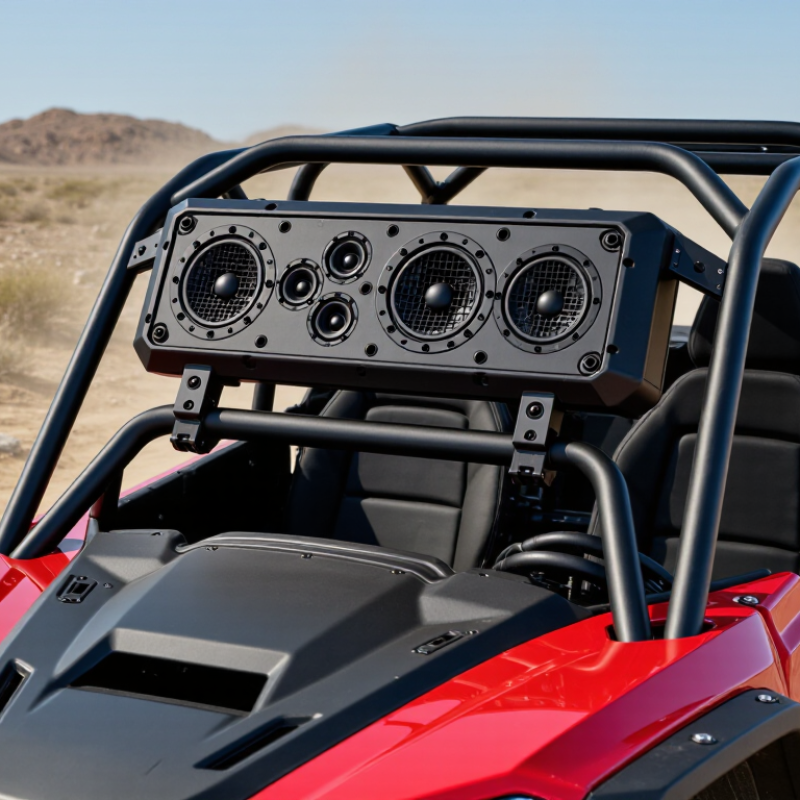
Choosing the best sound bar for an off-road vehicle starts with fit, not volume. A 2024 Grand View Research report estimates the global automotive audio market will grow steadily through 2030. That growth brings more compact products, but compact does not mean universal. Measure the available width, height, and mounting depth beside the dashboard or roll cage. Leave at least 10 millimeters of clearance for vibration and cable movement. A two-seat layout may accept a wider enclosure, while a four-seat layout often needs a narrower design.
Mounting points must match the vehicle’s tubing diameter and driving conditions. Use stainless hardware, locking nuts, and rubber isolation washers. The IEC 60529 standard defines IP water-resistance ratings, but an IP rating does not guarantee protection from mud impact or pressure washing. Wiring deserves equal attention. Use a fused positive lead near the battery, route cables away from exhaust heat, and secure them every 20–30 centimeters. Confirm the sound bar’s current demand before selecting wire size. The National Electrical Code’s ampacity tables are useful references, although mobile installations need extra allowance for vibration and voltage loss.
Tips: Photograph the original routing first. Test the sound bar before final tightening. Check polarity twice. I once assumed a factory accessory lead was sufficient; it overheated under sustained playback. That mistake was avoidable. Use a multimeter, inspect the ground point, and leave a small service loop near the connector. Fancy mounting can still fail when dust enters an unsealed plug.
Evaluate Outdoor Audio Performance: 80–100 dB SPL and ≤1% THD
Choosing the best sound bar for a Polaris RZR requires outdoor measurements, not showroom impressions. Target 80–100 dB SPL at the driver’s seat, where wind and engine noise compete constantly. Measure with a calibrated meter, one metre from the speakers, then repeat at the passenger seat. IEC 60268-21 provides a recognized method for loudspeaker sensitivity and maximum-output testing. Use pink noise and music tracks, because one test tone can hide harshness.
Keep total harmonic distortion at or below 1% at normal listening levels. Test THD at 80, 90, and 100 dB SPL, preferably across 100 Hz to 10 kHz. A clean 90 dB result is more useful than a distorted 105 dB peak.
The Audio Engineering Society recommends standardized measurement conditions, yet real trail conditions remain less predictable. Dust, vibration, roof reflections, and open sides can change the result. I would log each reading with engine speed and vehicle position.
Safety also matters. NIOSH identifies 85 dBA over eight hours as a recommended occupational exposure limit, using a 3 dB exchange rate. A 100 dB system can therefore become tiring quickly, even when it sounds exciting.
Start near 80–85 dB, then raise volume only when wind masks speech. Poor installation can create rattles.
That detail is easy to miss. More testing is needed on uneven terrain, because a quiet parking lot may produce overly optimistic results.
Select by CE/RoHS Compliance, QC Testing, Spare Parts, and Support
Choosing a sound bar for an off-road side-by-side requires more than loud output. CE and RoHS documentation should be clear, current, and traceable to the actual model. Ask for test reports, declarations, and material compliance records. Do not rely on a logo printed on a product page. That shortcut creates doubt.
QC testing should reflect real trail conditions. Look for vibration testing, water-resistance checks, thermal cycling, connector inspections, and distortion measurements at high volume. A practical inspection also checks mounting brackets and cable protection. I once focused too much on peak wattage. It sounded impressive, but it revealed little about durability. This remains an easy mistake to repeat.
Spare parts can decide whether a minor fault becomes expensive downtime. Confirm availability for remotes, wiring harnesses, mounting hardware, fuses, and replacement speakers. Support should include installation guidance, wiring diagrams, troubleshooting steps, and a reachable technical contact. Response time matters. So does clear English. Before purchasing, request a sample unit and inspect its seals, fasteners, and cable routing yourself. Small details often expose weak quality control. No product is perfect. A supplier willing to discuss limitations usually appears more reliable than one promising everything.
